The aerospace and defense industry works with the most demanding materials in machining. Titanium alloys are chosen for their strength-to-weight ratio; nickel-based superalloys for their strength at high temperatures. These same properties make them difficult to machine. In this article we summarize the key challenges of machining titanium and Inconel and the strategies that work on the shop floor.
Why are these materials difficult to machine?
| Property | Titanium (Ti-6Al-4V) | Inconel 718 | Effect on machining |
|---|---|---|---|
| Thermal conductivity | Very low | Low | Heat stays in the tool instead of leaving with the chip |
| Elastic modulus | About half that of steel | High | Springback and chatter in titanium |
| Work hardening | Moderate | Very high | The next pass cuts a hardened layer |
| Hot strength | High | Very high | High cutting forces |
| Chemical reactivity | High | Moderate | Adhesion to the tool, diffusion wear |
In short, most of the heat that leaves with the chip in steel stays at the cutting edge in these materials. That is the main reason tool life is short.
Strategies for machining titanium
- Sharp, positive geometry: Reduces cutting force and heat. Fine-grain carbide with PVD coatings is common.
- Low cutting speed, adequate feed: Cutting speed is kept well below steel values, while feed must be high enough to avoid rubbing.
- Constant tool engagement: Trochoidal and dynamic milling toolpaths keep engagement constant and balance the thermal load.
- Climb milling: Chips form from thick to thin, reducing rubbing.
- High-pressure coolant: Removes heat from the cutting zone and breaks chips.
- Avoid dwelling: Pauses where the tool rubs without cutting heat the surface and cause adhesion.
Inconel and nickel-based alloys
The defining characteristic of alloys such as Inconel 718 is work hardening. The layer hardened by one pass loads the tool on the next. Therefore:
- Cut with sufficient chip thickness to avoid rubbing; avoid unnecessary thin passes over the same surface.
- In turning, vary the depth of cut between passes or use round inserts and small entering angles to reduce notch wear.
- For rough turning, ceramic inserts (SiAlON or whisker-reinforced) allow much higher cutting speeds than carbide. Carbide is usually preferred for finishing.
- Keep the tool sharp; a dull edge accelerates work hardening.
Toolpath and programming tips
- Soft entry: Enter with a ramp or arc instead of plunging straight in. Sudden engagement is the most common cause of edge chipping.
- Avoid full slotting: If a slot is needed, use trochoidal or slicing strategies.
- Limit load in corners: Engagement angle rises quickly in internal corners; keep the corner radius larger than the tool radius or reduce feed.
- Support thin walls: Titanium’s low elastic modulus makes thin walls flex. Plan the machining sequence so rigidity is lost as late as possible.
- Monitor tool wear: Spindle load monitoring and defined tool life prevent unexpected breakage.
Drilling and threading
Drilling titanium and superalloys is especially difficult because heat is trapped in the hole. Through-coolant carbide drills evacuate chips reliably and protect both tool life and hole quality. In deep holes, continuous cutting with high-pressure internal coolant is preferred over peck drilling where possible, since every retract and re-entry exposes the edge to another impact.
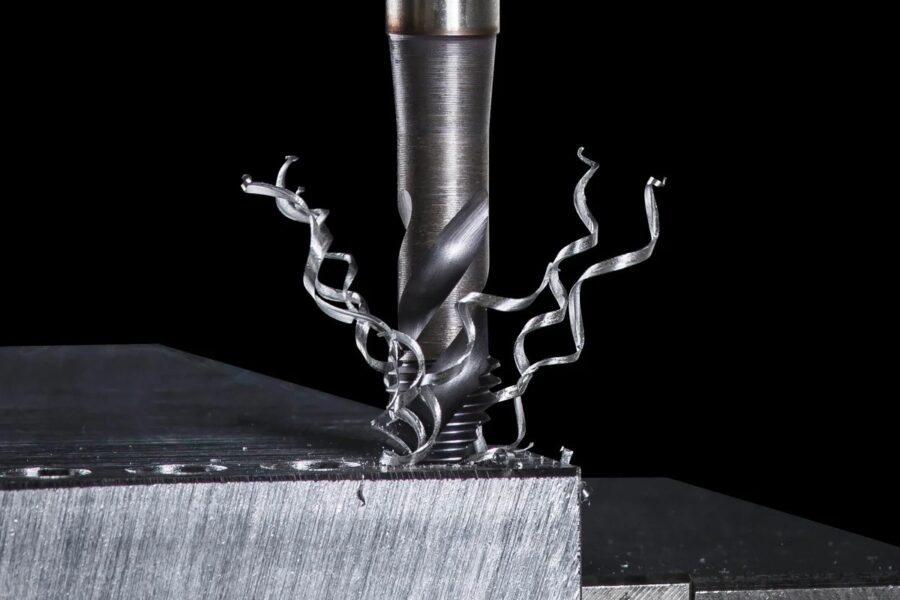
In threading, a broken tap is a costly failure. In these materials, thread milling is a safe alternative thanks to lower cutting forces, controlled chips and easy removal from the part if the tool breaks.
Beyond dimensions: surface integrity
For aerospace parts, the metallurgical condition beneath the surface matters as much as roughness. Excessive heat can lead to white layer formation, unwanted tensile residual stresses and reduced fatigue life. A sharp tool, controlled parameters and effective cooling protect not only tool life but also the service life of the part.
In this industry, repeatable and traceable processes are a core expectation of quality management systems such as AS9100. Keeping records of tools, parameters and tool life therefore matters even more.
Tool selection checklist
- Grades and geometries recommended for ISO S materials
- Through-coolant tools compatible with high-pressure coolant
- Short overhang and a rigid tool holder (hydraulic or shrink fit)
- Variable helix, vibration-damping end mill designs
- A defined tool life criterion and mandatory tool changes
We explain how parameters affect tool life in our article on cutting parameters and tool life, and holder selection in our tool holder selection guide.